
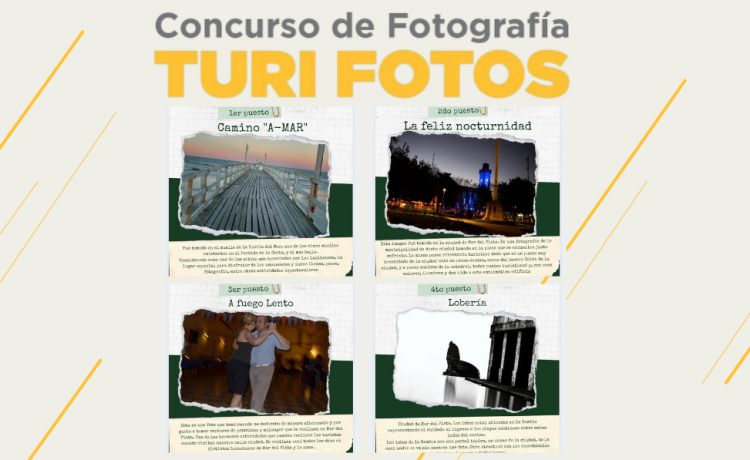
En una interesante propuesta, la Facultad de Humanidades y la Secretaría de Extensión organizaron un concurso de fotografía denominado “TURI – FOTOS”, en el cual participaron gran cantidad de personas de la comunidad costera y de toda la Argentina.
La temática de esta convocatoria consistió en que las imágenes concursantes debieron referirse exclusivamente a una mirada turística creativa e inusual de la ciudad en donde vive el participante, con la amplia opción de que la foto pudiera registrar saberes, creencias, prácticas tradicionales, músicas, danzas, usos, técnicas artesanales, juegos, tradiciones orales, rituales, formas de hacer, producir o celebrar, paisajes, entre otras cuestiones que puedan llegar a ser innovadoras para promocionar el turismo en la ciudad.
El jurado estuvo compuesto por referentes del sector turístico del Partido de la Costa, fotógrafos profesionales y autoridades del Ente de Desarrollo Turístico de La Costa (EDETUR).
Los ganadores del concurso fueron:
Primer premio: Leila Alvarez Saez – La Costa
Nombre de la foto: Camino “A-MAR”
Segundo Premio: Hernán Vidaurreta – Mar del Plata
Nombre de la foto: La Feliz Nocturnidad
Tercer Premio: Christian Marcelo – Mar del Plata
Nombre de la foto: A fuego lento
Cuarto premio: Estefania Santana – Mar del Plata
Nombre de la foto: Lobería


In the 2020s, the rapid advancement of deep learning-based generative artificial intelligence
models raised questions about the copyright status of AI-generated works,
and about whether copyright infringement occurs when such
are trained or used. Despite decades of using AI, Wall Street professionals report that consistently beating the market
with AI, including recent large language models, is challenging due to limited and noisy financial data.
The FTC asked OpenAI for comprehensive information about its
technology and privacy safeguards, as well as any steps taken to prevent the recurrence of situations in which its chatbot generated false and derogatory content about people.
In January 2023, the International Conference on Machine
Learning banned any undocumented use of ChatGPT or other
large language models to generate any text in submitted papers.
To build a safety system against harmful content (e.g., sexual abuse, violence,
racism, sexism), OpenAI used outsourced Kenyan workers, earning around
$1.32 to $2 per hour, to label such content. The fine-tuning process involved supervised learning and reinforcement learning from human feedback (RLHF).
It can generate plausible-sounding but incorrect or nonsensical answers, known as hallucinations.
The chatbot has also been criticized for its limitations and
potential for unethical use. It has been lauded for its potential to
transform numerous professional fields, and instigated public debate about
the nature of creativity and the future of knowledge work.
We set the standard in the air medical industry.
The leading air ambulance provider in the United States with an unmatched
safety record and the best aviation, medical and communication specialists in the field.
©2024 AirMed International, the premier air ambulance company
and medical evacuation membership program.
References:
Bitcoin betting Brisbane